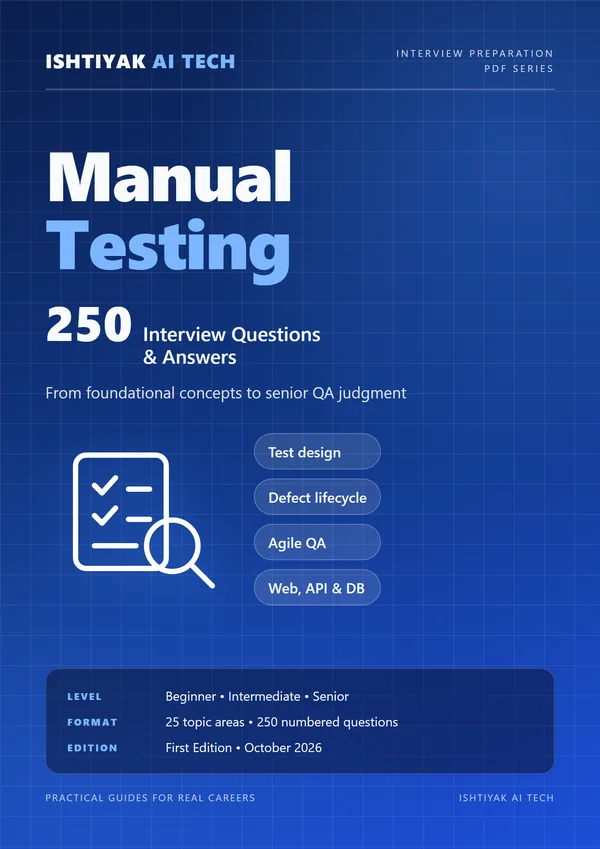
PDF guideManual Testing
Manual Testing — 250 Interview Questions & Answers
250 interview questions and answers on manual testing — from foundational concepts to senior QA judgment — with explanations, test-design examples, practical exercises and real-world scenarios.
- Questions
- 250 with answers
- Topic areas
- 25
- Level
- Beginner • Intermediate • Senior
- Edition
- First Edition • October 2026
₹299
What's inside
25 topic areas, 10 questions each.
- 01Manual Testing Foundations
- 02SDLC, STLC, and Testing Process
- 03Testing Levels and Types
- 04Black-Box Test Design Techniques
- 05Test Planning, Estimation, and Strategy
- 06Test Cases, Scenarios, and Test Suites
- 07Defect Life Cycle and Bug Reporting
- 08Agile, Scrum, and Team Collaboration
- 09Web Application Testing
- 10Mobile and Device Testing
- 11API and Integration Testing Concepts
- 12Database and SQL Testing Basics
- 13Performance, Load, and Reliability Testing
- 14Security Testing Fundamentals
- 15Usability, Accessibility, and Compatibility
- 16Test Environments, Builds, and Release Readiness
- 17Defect Prevention, Reviews, and Static Testing
- 18Metrics, Reporting, and Test Closure
- 19Real-World Manual Testing Scenarios
- 20Interview Communication and Career Skills
- 21Practical Exercises and Model Answers
- 22Test Management Tools and Workflow
- 23Test Data, Privacy, and Environment Safety
- 24Decision-Making, Ethics, and Professional Judgment
- 25Test Design for Common Business Domains
Sample questions
Excerpts from this guide's answers.
- Q2. What is manual testing?
- Manual testing is testing performed by a person who designs or executes checks without relying on a test script to perform the entire test flow automatically. The tester observes behavior, explores risks, and evaluates results against requirements or expectations.
- Q64. What is a blocker defect?
- A blocker prevents meaningful testing or a critical business activity, such as an environment that cannot start or a core workflow that cannot proceed. The label should be defined consistently within the project.